Why Google’s OKRs Work: The 70% Rule, Expected Failure, and How It Drives Long-Term Success

Clarity of direction is one of the most powerful drivers of organisational performance. When teams understand what truly matters and how their work contributes to wider objectives, decision-making improves, effort becomes focused, and momentum builds. Objectives and Key Results, commonly known as OKRs, offer a structured way to create this clarity while encouraging ambition and learning.
At EVOLVE HUB, we work with organisations to strengthen People and Culture while improving business operations. In that work, we often see how traditional goal-setting approaches can unintentionally limit performance. Goals that are designed to be fully achievable can encourage caution, safe thinking, and incremental progress. OKRs challenge this mindset.
Google’s approach to OKRs is often cited because it deliberately reframes success. Rather than expecting teams to achieve every objective in full, Google encourages teams to aim high enough that achieving around seventy per cent of their Key Results is considered a positive outcome. This expectation of partial completion is not a sign of poor performance. Instead, it is a signal that goals are stretching teams beyond what feels comfortable.
This article explores why Google’s approach works, how the idea of expected failure supports innovation and focus, and what organisations can learn when applying OKRs thoughtfully. We will examine the structure of OKRs, the thinking behind the seventy per cent rule, and the cultural and operational benefits that can follow when ambition is balanced with learning.
Key Takeaways
Google designs OKRs so that achieving around 70% signals strong performance, not failure
Stretch goals encourage focus, prioritisation, and innovation rather than safe thinking
OKRs work best when used as a learning and alignment tool, not a performance scorecard
Clear distinction between aspirational and committed OKRs prevents confusion
Psychological safety and regular check-ins are essential for OKRs to succeed
Did you know? At Google, consistently hitting 100% of OKRs is often viewed as a sign that goals were not ambitious enough.
OKRs Explained

OKRs are a goal-setting framework designed to connect strategy with execution. They consist of two components.
Objectives
An Objective defines what an organisation, team, or individual wants to achieve within a specific time period. Objectives are qualitative, directional, and intended to inspire action. A well-written objective is clear, meaningful, and focused.
Key Results
Key Results describe how progress towards an objective will be measured. They are quantitative and outcome-based. Each objective typically has between three and five Key Results that indicate whether the objective has been achieved.
Unlike task lists or activity plans, Key Results focus on impact rather than effort. Completing a task does not necessarily mean progress has been made. A Key Result should show a measurable change or outcome.
OKRs are usually set for a fixed cycle, often quarterly. They are reviewed regularly during the cycle and scored at the end. Scores are used to support learning and improvement rather than to assign blame.
A defining feature of OKRs is transparency. In many organisations, OKRs are visible across teams so that everyone can see how priorities align. This visibility supports collaboration, reduces duplication of effort, and helps teams understand how their work contributes to organisational goals.
OKRs are not a replacement for operational metrics or performance management systems. Instead, they sit alongside them, providing a framework for strategic focus and learning.
Google’s Approach to Expected Achievement Rates

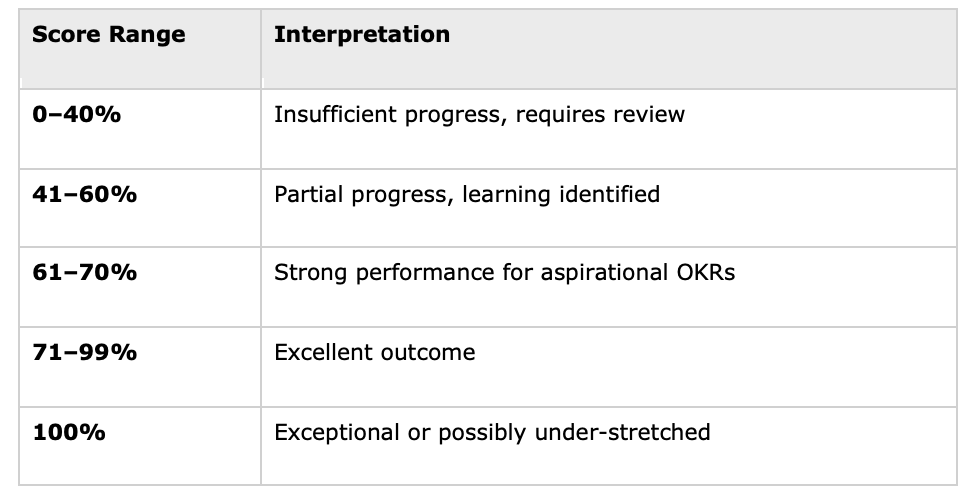
Google’s interpretation of OKRs includes a principle that often surprises organisations new to the framework. Success is not defined by achieving one hundred per cent of Key Results. Instead, achieving around seventy per cent is considered a strong outcome.
This approach is rooted in the concept of stretch goals. Stretch goals are intentionally ambitious. They are designed to push teams beyond what they already know they can deliver. If teams consistently achieve every objective in full, it suggests that the goals may not be ambitious enough.
When Google talks about expected failure, it does not mean poor execution or lack of accountability. It refers to the idea that some objectives are meant to be difficult enough that full completion is unlikely. The value lies in the progress made and the insights gained along the way.
This philosophy encourages teams to prioritise carefully. When resources and time are limited, teams must focus on the actions most likely to move Key Results forward. It also promotes experimentation, as teams explore new approaches to achieve challenging outcomes.
Importantly, this approach requires trust. Leaders must support teams in setting ambitious goals and avoid penalising them for not achieving one hundred per cent of aspirational objectives. Without this trust, teams may revert to safer goal-setting behaviours.
Google’s use of OKRs demonstrates how reframing success can unlock higher levels of performance, innovation, and learning.
Why Ambitious OKRs Deliver Better Results

Ambitious OKRs work because they influence behaviour in ways that traditional targets often do not.
Improved Focus
When teams are limited to a small number of objectives, they are forced to decide what truly matters. Ambitious Key Results highlight priorities and reduce the temptation to spread effort across too many initiatives.
Stronger Alignment
OKRs create alignment by connecting individual and team goals to organisational priorities. When everyone can see how objectives link together, collaboration improves and competing agendas are reduced.
Learning Through Challenge
Challenging goals surface gaps in capability, process, or resourcing. When a Key Result is not fully achieved, teams gain insight into what needs to change. This learning feeds into future planning and improves long-term performance.
Encouraging Innovation
Ambitious objectives encourage teams to explore new methods rather than relying solely on existing approaches. This can lead to innovation that would not emerge under more conservative goal-setting systems.
Reducing Complacency
OKRs discourage setting goals that are easily achievable. This helps organisations avoid complacency and supports continuous improvement.
Aspirational and Committed OKRs

Not all OKRs are designed to stretch in the same way. Distinguishing between aspirational and committed OKRs helps organisations apply the framework effectively.
Aspirational OKRs
Aspirational OKRs are designed to push boundaries. They often involve uncertainty and innovation. Achieving around seventy per cent of these OKRs is typically considered a strong result.
Committed OKRs
Committed OKRs represent outcomes that must be delivered. These may include regulatory requirements, critical launches, or contractual obligations. For committed OKRs, full achievement is usually expected.
Understanding the difference between these two types helps teams set appropriate expectations and avoid confusion about performance.
Typical OKR Scoring Guidance
People and Culture Benefits

OKRs can positively influence people and culture when implemented with care.
Psychological Safety
When teams understand that not all ambitious goals will be fully achieved, they are more willing to take informed risks. This supports psychological safety and open communication.
Motivation and Meaning
Clear objectives help individuals see how their work contributes to organisational success. This sense of purpose can improve engagement and motivation.
Shared Language
OKRs provide a consistent way to talk about priorities, progress, and outcomes. This shared language supports clearer conversations and better decision-making.
Coaching and Development
OKRs create opportunities for regular check-ins and reflective conversations. These coaching and development discussions support learning, growth, and capability development.
At EVOLVE HUB, we see the greatest impact when OKRs are combined with strong leadership behaviours and a culture that values learning.
Implementing OKRs in Practice
Successful implementation of OKRs requires structure and intent.
Step 1 Clarify Direction
Start by defining organisational priorities for the cycle. High-level OKRs should reflect strategic focus.
Step 2 Build Understanding
Ensure leaders and teams understand what OKRs are and how they differ from performance targets.
Step 3 Write Outcome-Focused Key Results
Key Results should describe measurable outcomes, not activities.
Step 4 Review Regularly
Short, regular check-ins help teams track progress, surface challenges, and adjust approach.
Step 5 Reflect and Improve
End-of-cycle reviews should focus on learning and improvement rather than blame.
Common Pitfalls to Avoid
Organisations often encounter challenges when adopting OKRs.
Setting too many objectives
Measuring tasks instead of outcomes
Expecting full completion of aspirational OKRs
Linking OKRs to pay too early
Lack of leadership commitment
Avoiding these pitfalls helps ensure OKRs support performance rather than hinder it.
Conclusion: Google OKRs Explained
Google’s approach to OKRs shows how redefining success can unlock higher performance. By expecting ambitious goals to be partially achieved, organisations encourage focus, innovation, and learning.
At EVOLVE HUB, we believe OKRs are most effective when embedded within a culture of trust, clarity, and continuous improvement. When people understand what matters and feel supported in aiming high, organisations are better positioned to achieve meaningful and sustainable results.
If you want to build clarity, alignment, and momentum across your organisation, speak to us about strengthening your People and Culture and business operations.
Further Reading
● Set Goals with OKRs: Google’s official guidance on how OKRs are designed, scored, and reviewed in practice.
● Objectives and Key Results (OKRs): A clear overview of OKRs, their origins, and how organisations apply them.
● Psychological Safety and Learning Behaviour in Work Teams: Research exploring how psychological safety supports learning, performance, and innovation.